One Product Store vs Niche Store vs General Store: Which Should You Start?
Compare focused, niche and general store formats, their trade-offs, and fictional Storalo layouts before choosing your launch brief.
Key takeaways
- Verify the real product, audience, costs, and fulfillment before committing to a launch.
- Storalo prepares ready stores; sales depend on products, marketing, and your effort.
- Use the practical checks below instead of assumed results or guaranteed timelines.
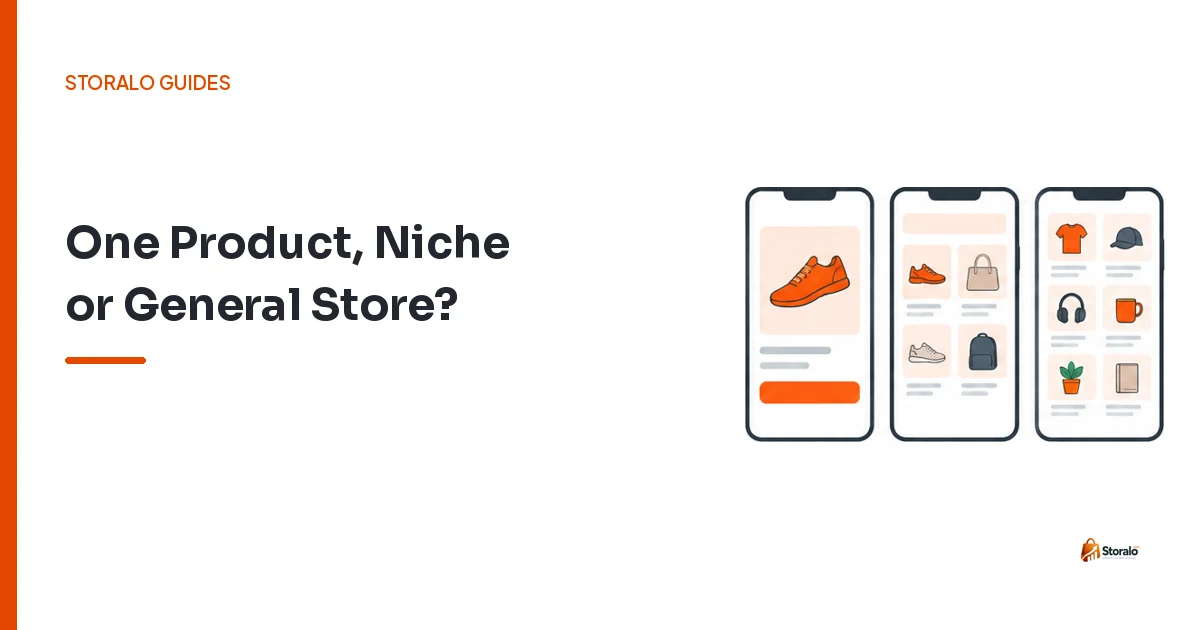
A one-product store focuses attention on a single main offer. A niche store serves a defined audience with several related products. A general store sells across unrelated categories. None is automatically the best option for every beginner, and none removes the need for product validation or a workable customer acquisition plan.
Storalo sells ready-to-sell Shopify stores, so this decision is about the brief for your store rather than a recommendation to build one yourself. Choose the structure that makes your customer, offer, and next test clearest. Sales still depend on the products, marketing, fulfillment, and effort behind the storefront.
What the three store types actually mean
One-product store
A one-product store organizes its homepage and navigation around one hero product. Different sizes, colors, or carefully related accessories do not necessarily change that focus. The shopper should understand the main offer without browsing a large catalogue.
This structure works best when the product needs explanation or demonstration. The homepage may resemble a detailed product presentation, with benefits, use cases, specifications, shipping information, and questions arranged around one purchase decision. It still needs contact information, policy pages, and a usable checkout.
Niche store
A niche store serves one recognizable interest, customer group, or problem area. A coffee-accessory store could offer a grinder, dripper, scale, and storage container because the products relate to the same routine. A random assortment of popular items is not a niche simply because everything has a similar color.
The structure gives shoppers a reason to explore related products. Collections, navigation, and product comparisons matter more than they do on a narrowly focused one-product page. The brand promise should be specific enough to explain why the catalogue belongs together.
General store
A general store offers products from different categories under a broad identity. It can make changing test products operationally convenient, but it may be harder to communicate expertise or a clear customer promise.
A general store is not permission to create a confusing catalogue. Visitors still need understandable navigation, accurate product pages, and a credible business identity. If your advertising sends shoppers to individual products, those pages must stand on their own rather than depend on an unrelated homepage.
Compare the trade-offs
The table describes typical planning trade-offs, not measured performance or guaranteed outcomes. Actual costs depend on the product, creative work, advertising channel, and store scope.
| Decision | One-product store | Niche store | General store |
|---|---|---|---|
| Cost to test | Focused content, but a failed hero product may require repositioning | Related products can share an audience, with more catalogue preparation | Broad testing flexibility, but each unrelated offer needs its own content |
| Ad targeting | One clear problem and purchase story | A defined audience with several relevant offers | Separate audiences may be needed for different categories |
| Trust | Deep product explanation can help; evidence must be genuine | Consistent niche expertise can support credibility | Broad identity needs extra clarity and consistency |
| Scaling | Add variants or genuinely related offers | Expand within the same customer need | Expand widely, but catalogue complexity increases |
| Risk | Concentrated on the main product and supplier | Spread across related items, with shared market risks | More product variety does not remove supplier or advertising risk |
| Repeat sales | Depends on replenishment, accessories, or repeat usefulness | More natural opportunities for relevant follow-up purchases | Repeat interest may be weaker when products are unrelated |
Who should choose a one-product store?
Consider it when you have a clear hero product, can explain a meaningful problem, and can obtain strong original photos or demonstrations. A focused page can make your message easier to understand when the audience does not yet know the product.
The concentration is also its weakness. Supplier problems, poor unit economics, or a product that needs unsupported claims can undermine the entire store. Do not choose the format merely because a video says one-product stores convert better. Ask whether your actual offer benefits from a focused presentation.
Before briefing Storalo, list the product's verified features, included parts, variants, target customer, and important limitations. Define what a buyer needs to know before purchasing. The resulting page should answer those questions, not imitate another brand's promises.
Who should choose a niche store?
A niche store is a sensible option when several products genuinely serve the same audience. It lets you lead with one offer while preserving room for complementary products, thoughtful bundles, and a clearer long-term identity.
Begin with a manageable range rather than filling every collection. Each item adds work: supplier checks, photos, specifications, prices, fulfillment details, and customer questions. A coherent small catalogue is more useful than a large selection you cannot accurately support.
Storalo can prepare a niche-focused ready store from your brief. Identify the audience first, then select product groups that belong together. Your future expansion should improve the same customer's experience rather than chase every unrelated trend.
When a general store might fit
A general format can suit someone deliberately testing different categories and willing to prepare distinct offers and content for each. It offers catalogue flexibility, but testing flexibility is not the same as easier sales.
If you are a beginner with a limited content budget, unrelated products can divide your attention. You may need different advertising audiences, photography styles, shipping explanations, and support knowledge. The work can expand faster than expected.
You also need a reason for customers to trust the business beyond a collection of deals. Avoid conflicting visual styles, generic supplier descriptions, and mismatched policy promises. If the catalogue feels arbitrary, a niche direction may produce a clearer brief for your Storalo store.
See the design difference in Storalo demos
Luxeray's fictional demo design shows a hero-product-led layout: the LED mask gets prominent attention and supporting presentation. It also includes complementary products, so use it as an example of focused layout rather than a literal single-SKU business.
Browse the Storalo demo store catalogue to compare niche presentations. Aurelle groups jewelry around one brand direction, while Brewhaus presents coffee-related products. These are fictional demo designs, not client stores, trading businesses, or evidence of conversion performance.
Pay attention to structure rather than copying text. Does navigation support exploration? Can the hero product be understood quickly? Are related items easy to find without distracting from the main offer? These questions make demo browsing useful even before you have finalized your product list.
Choose a layout around the customer, not a trend label. Compare Storalo packages and tell Storalo whether your launch needs one main offer or a related catalogue.
Test one product, then expand coherently
Start by defining a product hypothesis: who needs it, what problem it addresses, what it will cost to deliver, and why your presentation is credible. Supplier samples and basic margin calculations come before assuming an attractive page will generate demand.
Prepare original product content and direct relevant visitors to the offer. Watch the full journey rather than only views or likes. Questions, carts, and checkout activity can help identify what to investigate, but they do not guarantee eventual profitability.
If the offer gains useful evidence, consider products that solve the next related problem. A coffee dripper might lead naturally to a scale or filters; a random phone accessory would change the store's identity. Before expansion, confirm supplier reliability and shipping compatibility for the added items.
You may also keep the hero product as the homepage focus while adding a small collection behind it. Moving toward a niche store does not require removing the offer that attracted attention. Storalo can structure the catalogue so the main product remains obvious and related browsing stays simple.
Brief the design around the store type
For a one-product direction, prioritize clear hero media, an understandable benefit headline, accurate options, and supporting details in a logical order. Reduce navigation distractions without hiding shipping, returns, or contact information.
For a niche direction, ask for usable collections, consistent product photography, and meaningful category names. The homepage should establish the audience and offer routes into related products. Avoid collections so broad that every product could belong to every section.
For a general direction, emphasize navigation and standalone product pages. Each landing page must explain its own offer clearly. Keep the overall brand consistent even when products vary, and be realistic about the content work required to maintain that consistency.
For page-level planning, read what useful dropshipping product pages have in common. Before launch, use the 30-point store readiness checklist to catch operational gaps that store structure alone will not solve.
Get your chosen format with Storalo
Do not spend the whole launch budget debating labels. Pick the format that fits your current evidence, product range, and ability to create relevant content. You can refine the direction later, but a coherent first brief is more useful than trying to launch every possible product at once.
Order a Storalo Starter Ready Store for a focused starting scope, or compare larger packages when your catalogue requires them. Storalo prepares the storefront; you continue validating products and running the business. A ready-to-sell store is a launch foundation, not a promise of first sales or repeat purchases.
Frequently Asked Questions
Is a one-product store better than a niche store?
Neither is always better. A clear hero product may suit a focused layout, while related products can fit a niche store. Choose based on your audience, product evidence, content capacity, and supplier arrangements rather than a promised conversion advantage.
Can a one-product store sell accessories?
Yes. A store can focus on one hero offer and include relevant accessories or variants. Luxeray is a fictional hero-product-led demo with complementary items, not a literal single-SKU business or evidence of sales.
Is a general store suitable for beginners?
It can suit deliberate testing across categories, but each unrelated offer may require different content, audiences, and product knowledge. Limited attention and budget can make a coherent niche easier to plan; neither format guarantees orders.
Can I grow a hero-product store into a niche store?
You can add complementary products that serve the same customer. Check costs, supplier reliability, and fulfillment before expanding. Keep the main offer clear rather than adding unrelated trends simply to increase catalogue size.
Which format can Storalo prepare?
Use Storalo demo designs to identify the presentation you need, then brief your product range and target market. Storalo packages define the storefront scope. The owner remains responsible for product validation, marketing, fulfillment, and ongoing operations.
Sources and references
Prices and platform features were checked on November 23, 2026 and can change. Cost ranges for third-party services are illustrative estimates, not quotes.
About the author: Storalo team
The Storalo team writes practical guides for beginners launching ready-to-sell Shopify stores. Storalo is an independent store design service, not affiliated with Shopify Inc. Product choice, marketing, and ongoing store operations remain the owner's responsibility.