How to Find Winning Dropshipping Products Without Paid Tools
Use free research sources, supplier checks and simple margin math to choose products worth testing, without guaranteed-winner claims.
Key takeaways
- Verify the real product, audience, costs, and fulfillment before committing to a launch.
- Storalo prepares ready stores; sales depend on products, marketing, and your effort.
- Use the practical checks below instead of assumed results or guaranteed timelines.
You do not need a paid research subscription to begin evaluating dropshipping products. Public search, ad libraries, marketplaces, and supplier listings can help you build a shortlist. They cannot identify a product that is guaranteed to sell profitably in your store.
The useful goal is a product worth testing, not a supposed winner. Storalo prepares ready-to-sell Shopify stores after you choose a direction, so you can focus your preparation on the audience, supplier, offer, and original content. Sales depend on those decisions, marketing, fulfillment, and your effort, not access to a secret product list.
What makes a product worth testing?
Start with a recognizable problem or desire. Can you explain who the product is for and why they might want it? An item with a clear use is easier to evaluate than one selected only because it appeared in a viral video.
Visual demonstration can help when it accurately shows the product's usefulness. A “wow” moment is attention, not proof of buying intent. Check whether the effect is real, repeatable, and legal to advertise for the specific item you will supply.
Margin also matters. A product may attract interest but leave too little room for shipping, payment fees, acquisition, and problems. Availability in local shops or large marketplaces is another factor: buyers need a credible reason to choose your offer rather than a familiar alternative.
Avoid products whose appeal depends on unsupported medical, safety, or performance claims. Review product requirements, intellectual property, and platform restrictions before committing to samples or advertising. Novelty does not remove these responsibilities.
Use free sources as different clues
Each source tells you something different. Treat the table as a research map, not a ranking of tools or a claim that all features remain available without an account.
| Source | Useful clue | What it cannot prove |
|---|---|---|
| TikTok search and Creative Center | Demonstrations, hooks, questions, and visible trends | Your future sales, margin, or permission to reuse media |
| Meta Ad Library | Active offers, positioning, and creative approaches | A competitor's profit or your likely acquisition cost |
| Amazon Best Sellers and Movers & Shakers | Category activity and changing sales ranks | Exact demand for your independent store |
| AliExpress listings | Supplier options, variants, indicative prices, and displayed order activity | Reliable quality or profitable retail demand |
| Google Trends | Relative search interest, geography, and seasonality | Absolute search volume or a sales forecast |
TikTok search: look beyond view counts
Search for the problem, use case, and audience as well as the product name. A coffee accessory might appear in routine videos, storage questions, or demonstrations, not only posts using a dropshipping hashtag.
Read comments for practical questions: dimensions, price, compatibility, delivery, and where to buy. Distinguish curiosity from a specific buying need. Repeated complaints about a product can reveal limitations, but comments are not a representative survey of all customers.
Save the product idea and the question it seems to answer. Do not download another creator's video for your ads without permission. Use the research to plan original demonstrations with your own sample and accurate claims.
TikTok Creative Center: research the presentation
TikTok describes its Creative Center as a free public resource for trends, ad examples, and creative tools. Available views, features, and access requirements can change; use the options currently offered for your region.
Compare hooks, demonstrations, problem framing, and the questions answered by visible ads. Look for ways to explain the product rather than simply imitate a successful-looking format. An engaging moment can inform your content brief without proving that the advertiser's store is profitable.
Country and category context matter. A trend in a market you cannot serve is not a ready-made opportunity. Check supplier delivery and your own customer problem before investing time in recreating the presentation with original media.
Meta Ad Library: study offers, not assumed profits
Search the Meta Ad Library for brands and products in your category. Review visible creative, landing offers, and the way advertisers explain benefits. Search availability and the information displayed depend on the ad category and market.
An active ad is evidence that an ad is visible, not proof of profitability. It does not reveal the advertiser's full costs, return rate, supplier arrangement, or results for your audience. Do not treat a long-running creative as a guaranteed business model.
Write down useful questions: does the offer emphasize a bundle, a specific audience, or a practical demonstration? Then verify whether your own product could support that positioning honestly. Never reuse another brand's testimonials, logo, or claims as evidence for your store.
Amazon lists: look for recurring needs
Browse Amazon Best Sellers in a relevant category and Movers & Shakers for changes in sales rank. Lists change, and rank movement should not be read as an exact unit-sales figure.
Look for groups of products solving related problems. Read descriptions and customer feedback to understand sizing concerns, fragile parts, missing accessories, or difficult instructions. These details can help evaluate whether an improved explanation or a different variant would matter.
Amazon shoppers may value marketplace convenience and delivery speed differently from visitors to an independent store. Popularity there does not prove customers will choose your offer. Compare the complete value proposition rather than only the product photograph.
AliExpress: verify the supplier side
Search for several listings of the same kind of item. Compare variants, destination shipping, processing information, descriptions, and available supplier feedback. Displayed order counts are one clue about listing activity, not verified demand for your future business.
Ask questions about the actual model, included parts, packaging, and what happens if an item is damaged or missing. A listing price can change with quantity, variant, and delivery destination. Use a written quote or checkout estimate for the configuration you intend to sell.
Order a sample where practical and inspect it. Supplier photos and high activity cannot confirm the quality of the item you receive. Do not commit to advertising claims until the product and any required evidence support them.
Google Trends: check geography and seasonality
Use a product term, problem phrase, or relevant topic, then select your target country and compare different time ranges. A seasonal spike may be meaningful, but it might arrive too late for your supplier's shipping schedule.
Google's Trends data explanation describes normalized search interest. The scale is relative, not a count of searches, and low-volume terms may not show enough data. An upward line is not a forecast of orders.
Compare related terms carefully. A broad topic and a narrow product phrase are not equivalent measures. Look for whether several sources support the same customer need, and record uncertainty instead of turning every positive-looking chart into a buying recommendation.
Once you have a coherent shortlist, browse Storalo's fictional demo storefronts and compare ready-store packages. Storalo prepares the site while you validate the products and offer.
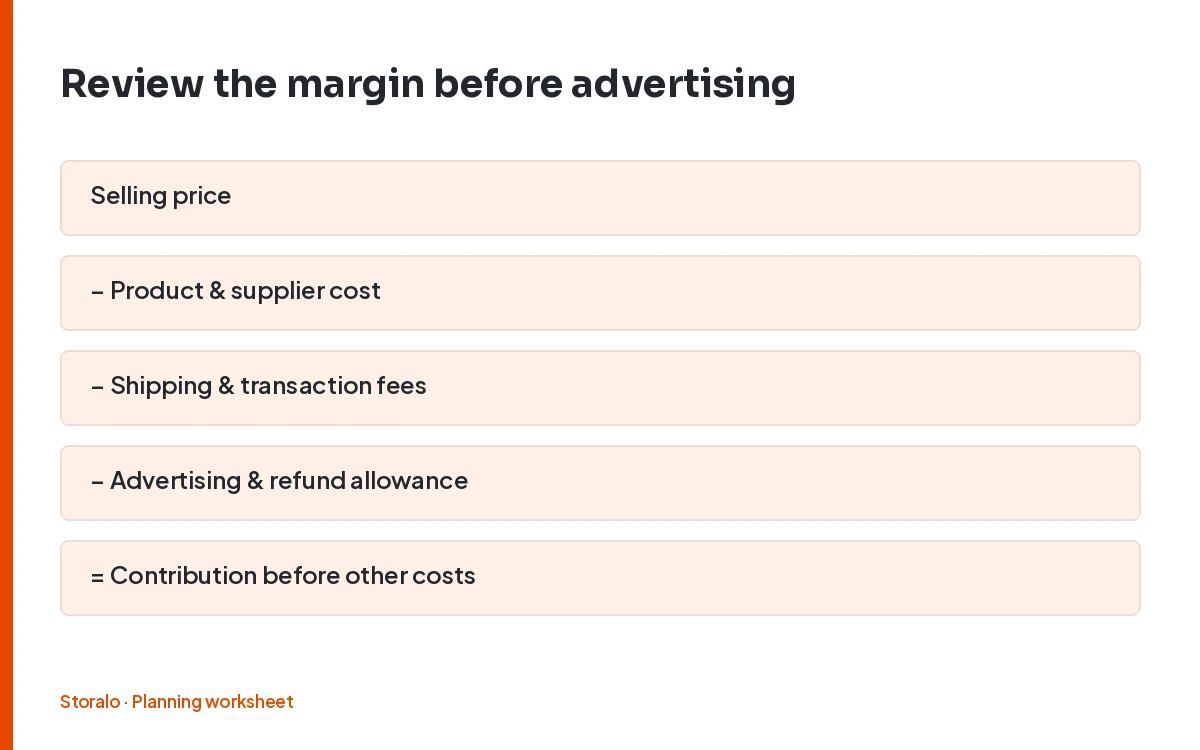
Calculate a basic margin before advertising
Use actual supplier costs when possible. The example below is hypothetical arithmetic, not a real product quote, client result, or recommended target margin.
| Component | Hypothetical amount | Meaning |
|---|---|---|
| Selling price | $40 | Amount paid for the item in this simplified example |
| Product cost | $12 | Supplier item cost |
| Shipping | $5 | Supplier delivery cost |
| Ad cost per sale | $10 | Assumed acquisition cost, not a prediction |
| Remainder before other costs | $13 | $40 − $12 − $5 − $10 |
The simplified formula is selling price minus product cost, shipping, and ad cost per sale. The remainder is not net profit. Deduct payment fees, refunds, chargebacks, applicable taxes, and operating costs as relevant. Actual advertising cost per sale is unknown until you test it.
Also check cash flow. You may need to pay suppliers before funds are available from your payment provider. Leave room for delays and customer problems rather than assuming every sale finances the next order immediately.
Validate before committing to paid traffic
Combine independent clues around the same customer problem. Check the sample, supplier, market, and costs, then prepare original content that answers the most important buying questions. A small shortlist is more useful than collecting dozens of unverified products.
You can learn from relevant organic responses, but likes and views are not purchases. If you run a paid test, set an affordable limit and define what you will review. Compare the audience, page, carts, checkouts, and orders instead of declaring success from attention alone.
Read the store-format comparison to decide how related products should fit together. Use the realistic first-sale timeline to plan work without assuming a fixed sales deadline.
Avoid the usual shortcuts
Do not select products only because someone calls them winners. Do not copy creative, overlook delivery, or calculate margin from the supplier price alone. Avoid regulated or risky categories you cannot evaluate properly, and do not keep spending simply to recover an earlier loss.
Order a Storalo Growth Ready Store when you have a suitable audience and product direction. Storalo gives the launch a defined storefront scope; it does not certify that your chosen product will sell. Keep validating the real offer before and after the store goes live.
Frequently Asked Questions
Can free tools find a guaranteed winning product?
No tool can guarantee profitable sales. Free sources can help you identify a customer problem, understand offers, and compare supplier options. Validate quality, costs, demand signals, and original content before committing to a test.
What does Google Trends measure?
Google Trends shows relative, normalized search interest rather than absolute search volume or sales. Compare geography and time periods carefully. Low-volume terms may not have enough data, and a rising chart does not predict orders.
Does an active competitor ad prove the product is profitable?
No. An ad library shows visible advertising and creative approaches, not the full economics of a competing business. You do not know its margins, refunds, or your own likely acquisition cost from the ad alone.
How should I calculate a basic product margin?
Subtract product cost, shipping, and acquisition cost per sale from the selling price, then account for payment fees, returns, tax, and operating costs as relevant. Hypothetical numbers are planning arithmetic, not a forecast of net profit.
Where does Storalo fit after product research?
Once you have a suitable audience and product direction, Storalo prepares a ready-to-sell Shopify storefront within the selected package scope. Continue checking suppliers, costs, content, and marketing; a ready store does not certify a winning product.
Sources and references
- TikTok: About Creative Center
- Google: FAQ about Trends data
- Meta Ad Library
- Amazon Best Sellers
- Amazon Movers & Shakers
Prices and platform features were checked on November 23, 2026 and can change. Cost ranges for third-party services are illustrative estimates, not quotes.
About the author: Storalo team
The Storalo team writes practical guides for beginners launching ready-to-sell Shopify stores. Storalo is an independent store design service, not affiliated with Shopify Inc. Product choice, marketing, and ongoing store operations remain the owner's responsibility.